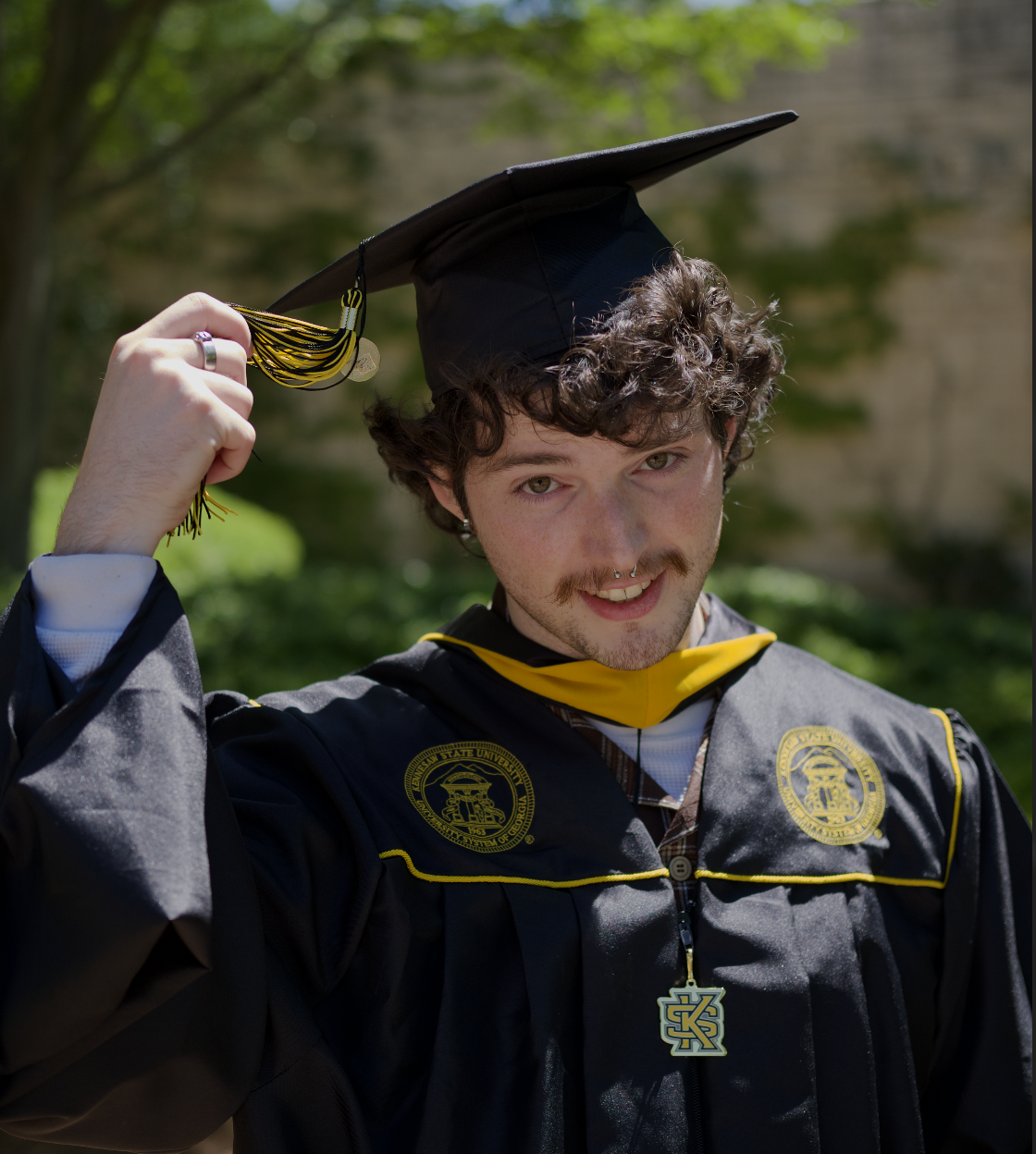
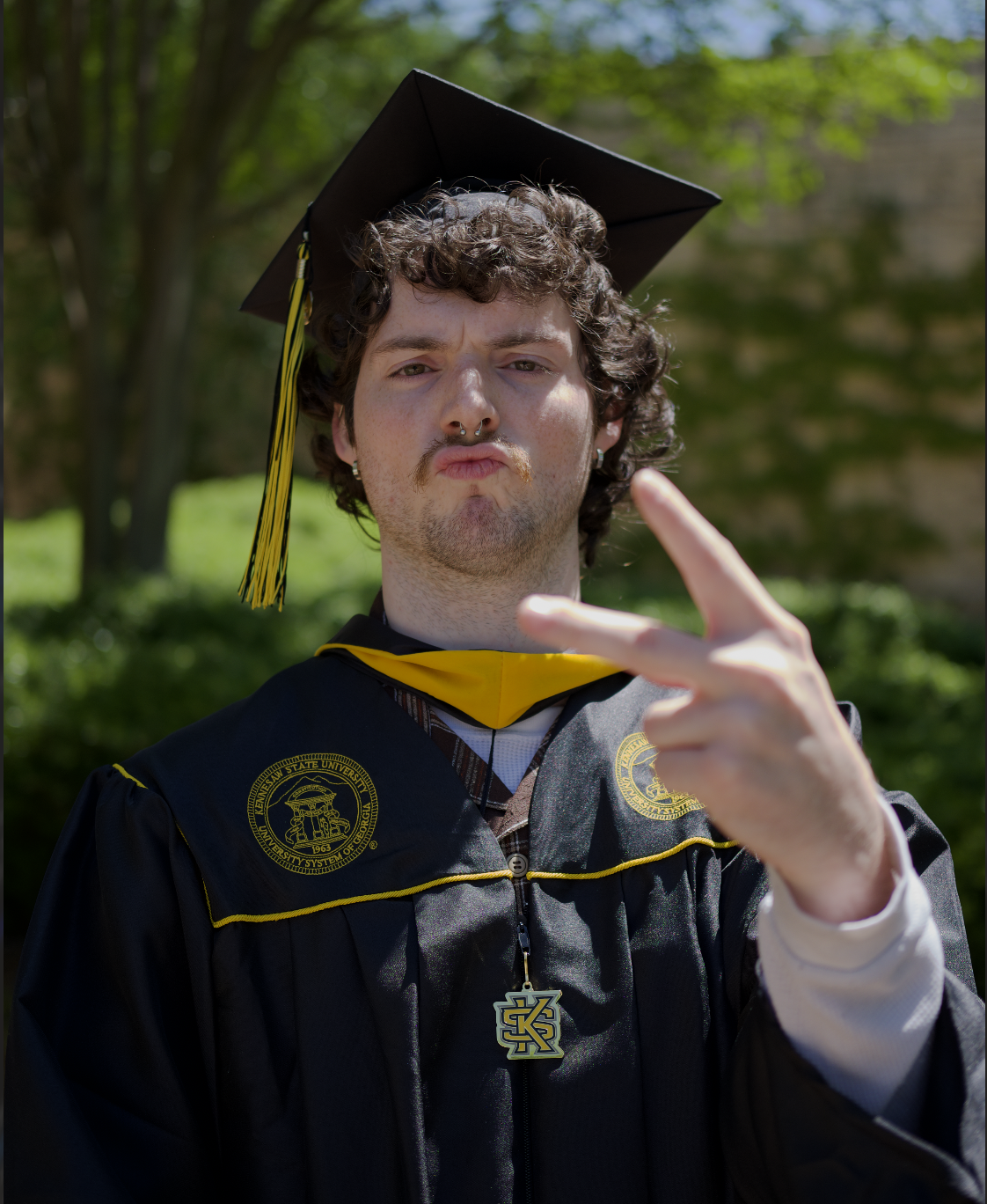
my main interests and career aspirations involve fusing the two–psychology and computer science, “left-brain” analytics and logic/math with “right-brain” mushy, subjective art. they have always lived as a dialectic in my life, and i can trace it back to how i’d answer my parents’ question, “what do you want to be when you grow up?” with a scientist-by-day-drummer-by-night compromise. i haven’t changed a bit.
below are my credentials, professional and academic; to see my hobby projects, check here
education
m.s. computer science (concentration: artificial intelligence) — kennesaw state university spring 2024 – may 2026 | gpa: 3.46 coursework: artificial intelligence, machine learning, neural nets & deep learning, natural language processing, machine vision, AI & robotics, information retrieval, graph algorithms (term project: bandgraph)
postbac certificate, computer science foundations — kennesaw state university spring 2024 – summer 2025
foundations coursework: theory of computation, advanced algorithms (graduate-level algorithm design and analysis), data structures & algorithms, mathematical structures for CS (discrete mathematics: logic, sets, counting, proofs, introductory graphs), foundations of programming
b.s. psychology (minor: biology) — kennesaw state university august 2018 – december 2021 | gpa: 3.2 undergraduate capstone: proposed aphantasia as a trauma dampener via interoceptive and autonomic mechanisms — subsequently validated against convergent 2025 literature across multiple independent papers
experience
psychometrist i — wellstar health system july 2026 – present
administer and score cognitive, ability, and psychological assessments for adult, geriatric, and pediatric patients — including pre-surgical psychological evaluations — in accordance with APA and national association of psychometrists (NAP) standards. document clinical encounters in the medical record and contribute b behavioral observations to comprehensive psychological evaluation reports.
psychometrist — georgia psychological associates february 2024 – december 2025
administer and score 20+ psychological assessments per month across a multi-specialty practice. evaluation contexts include SSA/social security disability determinations, DFCS child welfare and custody referrals, and forensic and court-ordered evaluations. instruments include WAIS-IV, WISC-IV, KABC-II, KBIT-2R, WASI, PAI, MMPI, BASC, BRIEF, Conners, Vineland, TSCC, and others. contribute behavioral observation sections to templated clinical reports under the supervision of 4+ licensed psychologists across specialties simultaneously. maintain records for 100+ clients with accuracy required for legal and federal review.
graduate research contributor — kennesaw state university fall 2024 – fall 2025
contributed to research on racial and academic placement influences on perceptions of intelligence and giftedness, presented at SEPA 2025. performed data analysis, literature review, and manuscript preparation under PI haley anthony, LPC. coordinated community-engaged research through boys and girls club of atlanta.
account coordinator — porter novelli (remote) july 2021 – july 2023
synthesized research on mental health, technology, and pharmacology into client deliverables. managed research bids and coordinated with third-party panel partners. conducted literature reviews and data analysis.
projects
embeddage — word-guessing game with 3d semantic visualization live | github word game built on GloVe embeddings with PCA-reduced 3D visualization of semantic space (50D → 3D via NumPy). Python preprocessing pipeline over an 11.9B-token Wikipedia corpus; TypeScript/Three.js frontend; Cloudflare Workers for leaderboard and player tracking.
nap (nimslo alignment pipeline) — computer vision pipeline for stereoscopic photo alignment github end-to-end pipeline for aligning 4-lens Nimslo camera photos into stereoscopic GIFs. U²-Net deep learning segmentation, SIFT feature matching, RANSAC-based homography estimation, IoU optimization across frames.
questionnaire-tts — accessibility tool for clinical assessment github web-based TTS player using Microsoft Edge neural voices for accessible psychological assessment administration. keyboard-navigable, audio-caching, packaged as a standalone Windows executable for clinical use.
self-hosted infrastructure — personal systems administration a small fleet (linux server, mac mini, 3 raspberry pis) running production services: two blogs, immich, a media server, and kiwix (offline wikipedia). configured tailscale VPN mesh for secure remote access and troubleshooting across networks. managed pi-hole DNS filtering. executed a full ISP and network migration (spectrum + eero to AT&T fiber), including cloudflare tunnels, DNS reconfiguration, and internal addressing changes. built an immich API-based cleanup utility accessible over the tailnet. maintained system monitoring, automated backups, documentation, and reliability routines; local sync of personal knowledge vault via gitea.
bandgraph — interactive shared-member network between bands live | course term project (graph algorithms) shipped late mar 2026. seed a band; pulls from musicbrainz and draws a D3 force-directed diagram of bands connected through overlapping personnel. live-build with user-set caps, inline disambiguation on multiple entity matches, click-to-expand from any band node merging into the same graph. includes algorithm demos (shortest path via BFS, neighborhood, bipartite walk) ported from Python to client-side JS.
ablemaps — TSP route optimizer for pediatric clinic outreach teams github built a traveling salesman problem route optimizer for metro atlanta outreach teams visiting 40+ pediatric clinics. held-karp exact TSP solver (O(n²·2ⁿ) DP) running client-side, paired with OSRM routing and leaflet/OSM maps. deep link chunking (google maps 10-stop, apple maps 15-stop). zero-cost architecture: cloudflare workers + D1.
textbook concept mapper — graph-based keyword extraction and concept maps from textbook text course term project (machine learning) textrank-style keyword extraction with spaCy preprocessing and networkx graph construction (co-occurrence / proximity-weighted edges). validated extracted terms against the book’s index (precision/recall/F1-style alignment). chapter-aware processing to preserve document structure.
gesture robot control — webcam hand gestures driving simulated robot motion github | course term project (AI & robotics) combined opencv, google mediapipe hand landmarks, and python robotics toolbox for real-time gesture interpretation → robot motion commands. end-to-end pipeline with configurable gestures.
labs-research — modular lab, faculty, and publication tracker for computational cognitive neuroscience github centralized markdown knowledge base with obsidian-style workflows. github actions automation queries crossref, arxiv, and biorxiv; downloads OA PDFs; converts to markdown with YAML frontmatter.
skills
languages & tools: Python (pandas, NumPy, OpenCV, NetworkX), TypeScript, SQL (basic), R (basic), Bash, Git, SPSS
web development: D3.js, Three.js, Vite, Cloudflare Workers
machine learning & AI: pytorch, tensorflow, scikit-learn, transformer fine-tuning (GPT-style), local LLM deployment (ollama, llama.cpp), word embeddings (GloVe), deep learning segmentation (U²-Net), computer vision (OpenCV, MediaPipe, SIFT/RANSAC, homography estimation)
research: psychometric theory, experimental design, literature review, statistical analysis, behavioral observation and coding, scientific writing, APA format
clinical assessment: full cognitive and behavioral battery administration (WAIS-IV, WISC-V, KABC-II, PAI, BASC, BRIEF, Conners, TSCC + others), disability/SSA, DFCS, and forensic evaluation contexts
systems: Linux server administration, network configuration, service deployment, VPN setup (Tailscale), Cloudflare Tunnels, DNS (pi-hole), Git, Wireshark (basic)
other: Adobe Photoshop, Adobe InDesign, German (DSD I certified)
research interests
my undergraduate capstone proposed that aphantasia — the inability to voluntarily form mental imagery — might function as a trauma dampener through interoceptive and autonomic mechanisms. i wrote it speculatively. since then, convergent 2025 literature has supported the framework from multiple independent directions. i’m currently pursuing a co-authored theoretical framework looking at aphantasia and its evolutionary basis, as well as exploring its modern exaptations.
more broadly: i’m interested in how minds vary in ways we can measure, what those variations mean for how people experience and recover from adverse events, and how computation might eventually help us intervene.
languages
english: native
german: B1/B2 (deutsches sprachdiplom stufe I, 2017)
awards
frederick douglass and susan b. anthony award (2018) — recognized for commitment to social justice
dean’s list — fall 2019, spring 2020, fall 2020